

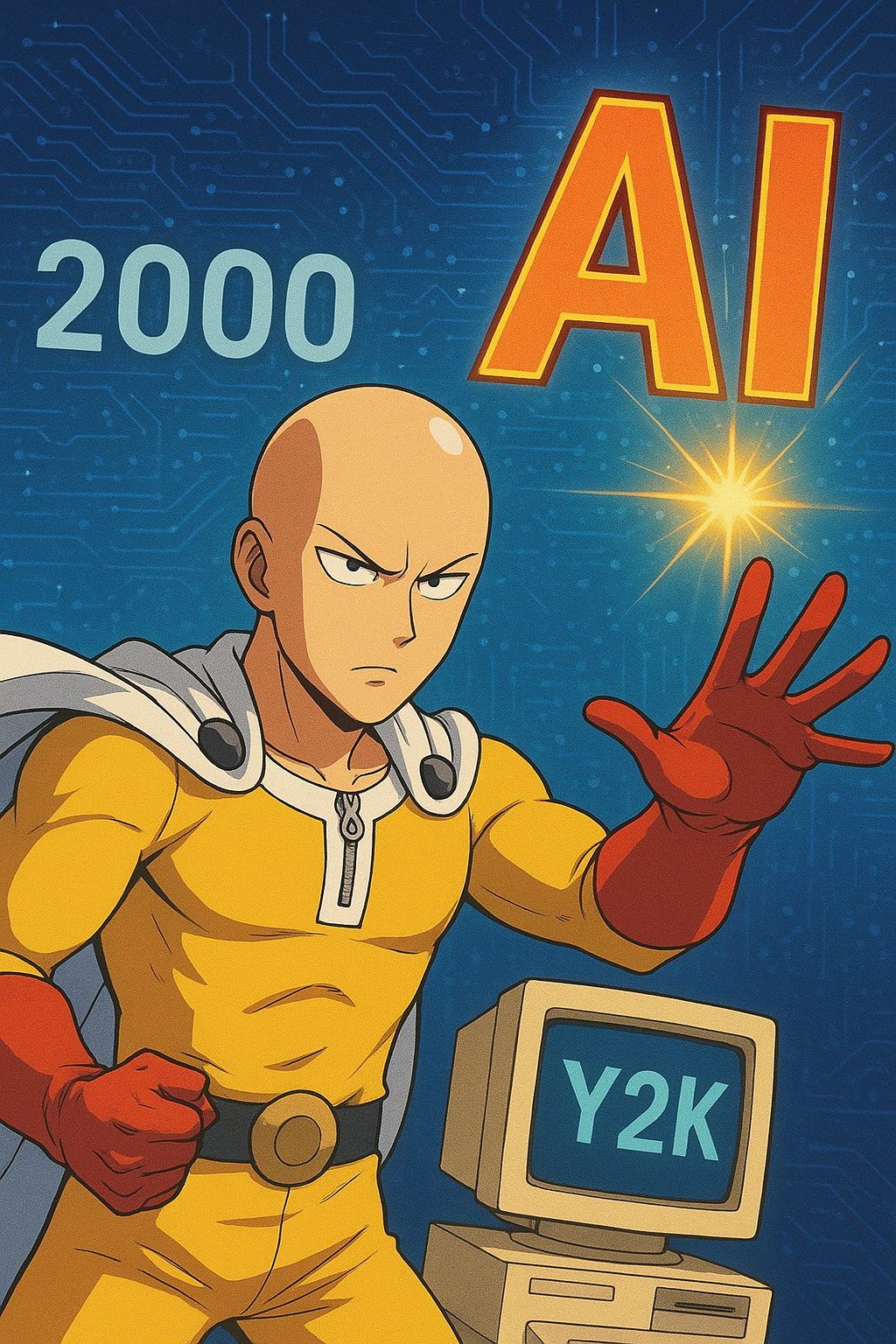
History repeats itself, often with a digital twist. At the dawn of the new millennium, the world held its breath as we approached the Y2K bug—a software flaw that threatened to cripple industries, governments, and daily life. Today, we face another turning point: the rise of Artificial Intelligence.
The parallel is striking: in both eras, organizations had a choice—adapt early and decisively, or resist and risk perishing.
Let’s revisit how some well-known firms navigated Y2K—successes and failures—and what their stories can teach us about embracing AI today.
AOL: The Scramble That Almost Broke the Internet
In early 1999, America Online (AOL) was the crown jewel of the internet, with tens of millions of users logging in daily through its famous dial-up service. But internally, AOL was alarmingly behind on Y2K compliance.
As late as February 1999, engineers still had not fully identified which systems were vulnerable. Key vendor information was missing, and testing hadn’t begun in earnest. AOL admitted that some of its proprietary systems might simply stop working on January 1, 2000.
The firm poured $8 million into a last-minute remediation program, pulling engineers from product innovation to firefighting. They avoided disaster, but at a cost: AOL’s competitors, like Yahoo!, were shipping new services and capturing user attention while AOL was buried in compliance chaos.
👉 Lesson for AI: Waiting until the last minute to integrate AI—whether in customer support, fraud detection, or personalization—means competitors will innovate while you’re still scrambling.
Prodigy: Death by Legacy Code
While AOL struggled but survived, Prodigy Communications wasn’t so lucky. Prodigy’s flagship “Classic” service was built on outdated, cobbled-together systems—engineers called it “spaghetti code.”
Making it Y2K compliant would have meant rewriting the entire architecture, a cost the company wasn’t willing to bear. Instead, Prodigy shut down Classic entirely. Many long-time customers left rather than migrate to its newer offerings, accelerating Prodigy’s decline as competitors surged ahead.
👉 Lesson for AI: Companies that cling to outdated processes instead of investing in AI-driven transformation may face the same fate: forced shutdowns, lost customers, and irrelevance.
Intuit: A Costly Lawsuit in Customer Trust
Software company Intuit, maker of Quicken, faced a different Y2K problem. Early versions of Quicken weren’t compliant—and customers weren’t warned. Some couldn’t reconcile accounts or run future-dated transactions as 2000 approached.
The backlash was swift. A class-action lawsuit accused Intuit of misleading customers and failing to deliver compliance in products it continued to sell. Eventually, Intuit had to provide free upgrades and absorb reputational damage.
👉 Lesson for AI: Transparency matters. Companies rolling out AI tools must be upfront about limitations and risks. Hiding flaws—bias, hallucinations, compliance gaps—invites lawsuits and erodes trust.
Chrysler & GM: Factories in the Dark
For automakers like Chrysler and General Motors, Y2K wasn’t an abstract IT bug—it was a production nightmare.
At Chrysler’s Sterling Heights assembly plant, Y2K testing brought security gates to a standstill. Employees couldn’t enter, and production ground to a halt. GM’s factories weren’t spared either. Early testing revealed robotic systems on the assembly line froze when system dates were advanced, creating the risk of cars stuck half-assembled on the line.
These failures didn’t make headlines in January 2000 because they were discovered during testing. But the lesson was stark: modern manufacturing was more dependent on software than anyone had realized.
👉 Lesson for AI: Today’s factories and supply chains face the same risks. Firms that fail to integrate AI into predictive maintenance, logistics, and robotics may find themselves disrupted not by bugs, but by faster, smarter competitors.
Shell: Hidden Risks in Embedded Systems
Perhaps the most chilling Y2K story came from Shell. During testing, the company discovered that 10–20% of embedded microprocessors in its global operations—from refinery controls to offshore rigs—were at risk of malfunctioning when the date rolled over.
These chips weren’t as simple to patch as software—they were buried in machinery, sometimes in remote or dangerous locations. Shell had to rush teams worldwide to replace hardware at staggering cost.
👉 Lesson for AI: The hidden risks of ignoring AI aren’t bugs, but blind spots. Companies may overlook AI’s role in cybersecurity, compliance monitoring, or IoT data interpretation—until those gaps are exploited.
Y2K’s Hidden Legacy: Growth and Opportunity
While some firms stumbled, others thrived. The Y2K remediation effort became the proving ground for India’s IT industry. Firms like Infosys, Wipro, and TCS cut their teeth rewriting code for Y2K compliance, catapulting them into the global spotlight. What began as bug-fixing contracts evolved into decades-long outsourcing relationships.
👉 Lesson for AI: Just as Y2K launched India’s IT rise, AI is creating new global leaders in data science, automation, and applied machine learning. The winners will be those who see beyond compliance and leverage AI to reinvent business models.
The Parallel With AI Today
Like Y2K, AI demands proactive adaptation:
- Banks ignoring AI-driven fraud detection risk losing customer trust.
- Retailers resisting AI personalization lose sales to more adaptive rivals.
- Manufacturers that won’t use AI for predictive supply chain optimization will lose margins.
- Service providers without AI automation will be undercut by faster, cheaper competitors.
Y2K taught us that change is non-negotiable. Those who resist perish. AI isn’t about survival—it’s about growth. But the principle is the same: the cost of inaction is far greater than the cost of adaptation.
Conclusion: History’s Warning
The millennium bug may seem like a “non-event” today, but only because trillions of dollars and millions of labor hours went into preventing disaster. Along the way, firms that resisted or delayed suffered—and some never recovered.
AI is our new Y2K, but with higher stakes. Where Y2K threatened to break systems, AI threatens to reorder entire industries. The companies that lean in will lead; those that resist will join Prodigy, forgotten in the archives of business history.
Adapt, or perish. The lesson is timeless.