Introduction
Real-time data pipelines power applications such as analytics dashboards, fraud detection systems, IoT platforms, and event-driven applications. In these pipelines, one of the biggest challenges is ensuring that every event is processed exactly once.
If the same event is processed multiple times, it can lead to duplicate records and inaccurate analytics. On the other hand, losing events results in incomplete data and unreliable reports.
While Apache Kafka provides features that reduce duplicate message delivery, achieving end-to-end exactly-once processing requires coordination between the producer, consumer, and the destination database. ClickHouse provides several capabilities that help build reliable ingestion pipelines by minimizing duplicates and maintaining data consistency.
In this article, we'll explore how exactly-once semantics work and how to implement a reliable Kafka-to-ClickHouse ingestion pipeline.
What Is Exactly-Once Semantics?
Exactly-once semantics (EOS) ensures that every event is processed one and only one time, even if retries, failures, or restarts occur during data ingestion.
In practice, this means:
- Every event is processed successfully once.
- Failed operations can be safely retried without creating duplicates.
- No events are unintentionally lost.
Implementing exactly-once semantics helps maintain accurate analytical results and ensures consistent data across downstream applications.
Why Do Duplicate Records Occur?
Duplicate records can appear in streaming pipelines for several reasons, including:
- Consumer crashes after writing data but before committing Kafka offsets.
- Network interruptions during data ingestion.
- Producer retries after temporary failures.
- Consumer restarts that reprocess previously consumed messages.
- Manual replay of Kafka topics for recovery or backfilling.
Without proper deduplication, these scenarios can result in the same event being stored multiple times in ClickHouse.
Kafka's Role in Exactly-Once Processing
Kafka includes several features that improve the reliability of streaming applications.
Idempotent Producers
Idempotent producers assign sequence numbers to messages, preventing duplicate writes caused by producer retries.
Benefits:
- Prevents duplicate messages during retries.
- Improves fault tolerance.
- Ensures safer message delivery.
Kafka Transactions
Kafka transactions allow multiple messages and consumer offset commits to be processed as a single atomic operation.
This ensures that either:
- All operations succeed, or
- None of them are committed.
Offset Management
Consumer offsets should only be committed after data has been successfully written to ClickHouse. This reduces the risk of losing data while allowing failed operations to be retried safely.
Although these Kafka features significantly improve reliability, they do not guarantee end-to-end exactly-once processing on their own. The destination database must also support mechanisms to handle duplicate events.
Building a Kafka-to-ClickHouse Pipeline
A common ingestion architecture looks like this:
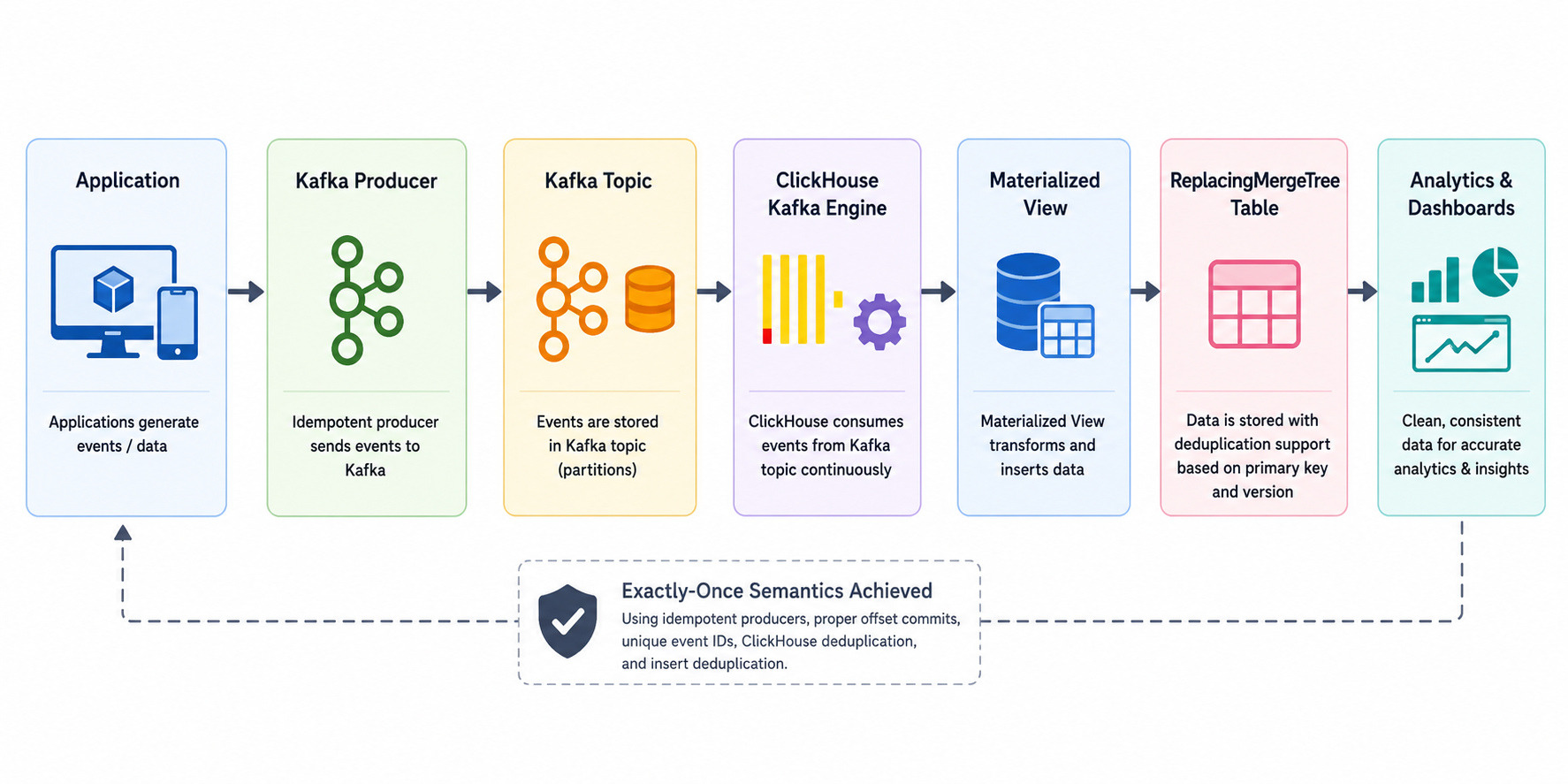
Let's look at the key components involved.
ClickHouse Kafka Engine
ClickHouse provides the Kafka Engine, which continuously consumes messages from Kafka topics.
Example
CREATE TABLE kafka_events
(
    event_id UUID,
    user_id UInt64,
    event_type String,
    event_time DateTime
)
ENGINE = Kafka
SETTINGS
    kafka_broker_list = 'localhost:9092',
    kafka_topic_list = 'events',
    kafka_group_name = 'clickhouse-consumer',
    kafka_format = 'JSONEachRow';
The Kafka Engine acts as a streaming source, allowing ClickHouse to consume Kafka messages without requiring a separate ingestion application.
Using Materialized Views for Continuous Ingestion
A Materialized View automatically transfers data from the Kafka Engine table into a MergeTree table for storage.
CREATE MATERIALIZED VIEW mv_events
TO events
AS
SELECT *
FROM kafka_events;
As new messages arrive in Kafka, the Materialized View continuously inserts them into the destination table, enabling near real-time ingestion.
Preventing Duplicate Records
Kafka reduces duplicate message delivery, but duplicate records may still occur due to retries, consumer failures, or replay operations.
ClickHouse provides several techniques to minimize duplicates.
1. Use Unique Event IDs
Every event should include a globally unique identifier, such as:
- UUID
- Transaction ID
- Event ID
Example
{
  "event_id": "3d9d34be-3f12-4c89-aef2-d53e5faad0c",
  "user_id": 42,
  "event_type": "purchase"
}
Using unique event identifiers makes it easier to identify duplicate events and maintain data consistency.
2. Store Data Using ReplacingMergeTree
ReplacingMergeTree is one of the most commonly used table engines for handling duplicate records.
CREATE TABLE events
(
    event_id UUID,
    user_id UInt64,
    event_time DateTime,
    version UInt64
)
ENGINE = ReplacingMergeTree(version)
ORDER BY event_id;
When multiple rows share the same primary key (event_id), ClickHouse retains the row with the highest version value during background merges.
This approach is particularly useful for:
- Retry scenarios
- Event updates
- Slowly changing records
3. Enable Insert Deduplication
For replicated tables, ClickHouse supports insert deduplication.
SET insert_deduplicate = 1;When enabled, ClickHouse ignores duplicate insert blocks with identical checksums, helping prevent repeated inserts caused by retries or temporary failures.
Best Practices
To build reliable Kafka-to-ClickHouse pipelines, consider the following recommendations:
- Enable Kafka idempotent producers.
- Use Kafka transactions when appropriate.
- Generate globally unique event IDs for every message.
- Commit Kafka consumer offsets only after successful ClickHouse inserts.
- Use
ReplacingMergeTreefor retry-safe ingestion. - Enable insert deduplication on replicated tables.
- Design tables with stable primary keys.
- Monitor Kafka consumer lag and ingestion failures.
- Test recovery scenarios, including consumer restarts and retries.
Limitations
Although these techniques significantly improve reliability, exactly-once semantics is not achieved automatically.
Keep in mind:
ReplacingMergeTreeperforms deduplication during background merges rather than immediately after insertion.- Applications must manage Kafka offsets correctly to avoid reprocessing events.
- Replaying Kafka topics without unique event identifiers can still introduce duplicate records.
- End-to-end exactly-once behavior depends on the combined implementation of Kafka producers, consumers, and ClickHouse.
Conclusion
Building reliable real-time data pipelines requires more than just streaming data from Kafka into ClickHouse. To minimize duplicate records and ensure consistent analytics, it's important to combine Kafka's reliability features with ClickHouse's ingestion and deduplication capabilities.
By using idempotent producers, proper offset management, Materialized Views, unique event IDs, and ReplacingMergeTree tables, you can create ingestion pipelines that handle retries and failures gracefully while maintaining data integrity. Although achieving true end-to-end exactly-once semantics depends on the entire data pipeline, these best practices provide a solid foundation for building scalable, fault-tolerant, and reliable streaming analytics solutions with ClickHouse and Kafka.
Key Takeaways
- Exactly-once semantics ensures every event is processed only once.
- Kafka reduces duplicate message delivery using idempotent producers, transactions, and offset management.
- The ClickHouse Kafka Engine enables direct streaming ingestion from Kafka.
- Materialized Views automate continuous data ingestion into MergeTree tables.
ReplacingMergeTreehelps eliminate duplicate records during merges.- Unique event IDs are essential for identifying and preventing duplicate events.
- Insert deduplication adds another layer of protection against repeated inserts.
- Combining Kafka and ClickHouse best practices results in reliable, scalable, and duplicate-resistant real-time analytics pipelines.
References
- ClickHouse Documentation: https://clickhouse.com/docs/integrations/kafka/kafka-table-engine
- Apache Kafka Documentation: https://kafka.apache.org/documentation/