

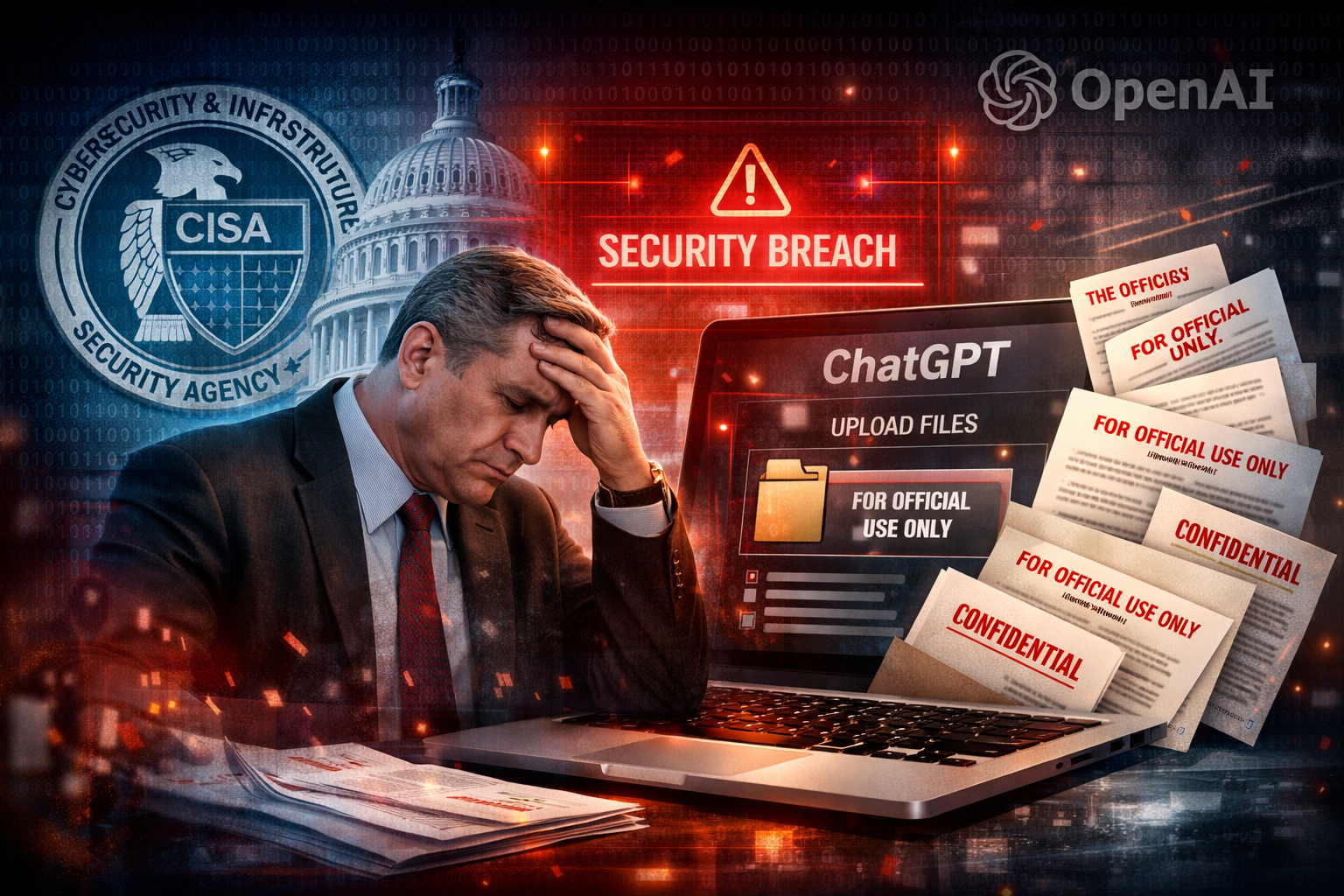
In what might be one of the most jaw-dropping AI privacy incidents of 2026, the acting head of the U.S. Cybersecurity and Infrastructure Security Agency (CISA) inadvertently uploaded sensitive government documents into the public version of ChatGPT – a public AI chatbot used by millions worldwide. The irony is stark: the very agency tasked with shielding American networks from cyber threats became the center of its own digital breach.
The incident did not involve top-secret classified files – but it did involve material marked “for official use only,” a designation that federal agencies apply to sensitive information that should never be shared publicly.
A Fateful Decision: When AI and Human Error Collide
The story unfolded last summer when Dr. Madhu Gottumukkala, acting director of CISA – the U.S. agency charged with defending government networks from hackers and nation-state adversaries – was granted special permission to use ChatGPT, even though most employees in the Department of Homeland Security (DHS) were blocked from accessing the public platform.
Shortly after gaining access, Gottumukkala uploaded internal contracting documents into ChatGPT – an AI system owned and managed by OpenAI with more than 700 million active users globally.
Almost immediately, internal cybersecurity sensors flagged the uploads, triggering automated alerts designed to detect potential leaks from federal networks.
This was no small oversight. By pushing sensitive government data into an AI platform whose outputs could potentially be influenced by that data, sensitive information was suddenly floating in the AI ecosystem – accessible to OpenAI engineers and possibly even woven into how the model responds to future prompts.
Irony of Ironies: The Defender Becomes the Vulnerable
CISA’s mission is to protect the nation’s critical infrastructure – from power grids to election systems, from emergency services to federal networks. Yet here was its own leader unknowingly exposing internal information to a mass-market AI service.
Senior DHS officials launched a full internal review to assess whether this exposure had harmed national security. The outcome remains undisclosed. However, sources say the incident sparked intense scrutiny within the agency – not just over the breach itself, but over how and why a senior official was using a public, unsecured AI tool for work that involved sensitive information.
Worse, this breach came at a time when federal agencies are trying to integrate AI into operations safely – often under strict controls to keep data on secure government servers. ChatGPT, by contrast, is a public platform where inputs could be stored, analyzed, or even reused in training future models.
What This Means for AI and Government Data Security
This incident highlights a critical lesson: AI convenience cannot trump data governance – especially in government. Even if a tool is powerful, its use must align with security protocols, especially when sensitive information is at stake.
AI systems like ChatGPT are designed to learn from data – including user inputs – which means that once information is fed into them, it might be used to influence future outputs for all users. For public safety, intelligence, and national cybersecurity bodies, that risk is unacceptable.
Moreover, this incident illustrates the growing tension between AI adoption and data protection. Many organizations – public and private – are struggling to balance the productivity gains from modern AI tools with the imperative to safeguard sensitive information.
Looking Ahead: Trust, Accountability, and AI Governance
The CISA ChatGPT incident serves as a vivid cautionary tale: even seasoned cybersecurity professionals can fall prey to the lure of cutting-edge AI without fully appreciating the privacy ramifications.
As AI tools continue to spread into government and enterprise workflows, clear policies, strict training, and robust oversight are essential to prevent similar missteps. Otherwise, we risk not just data leaks – but the erosion of public trust in institutions charged with defending against exactly these kinds of threats.
In a world where AI is becoming as indispensable as it is powerful, governing how it is used is just as important as what it can do.