

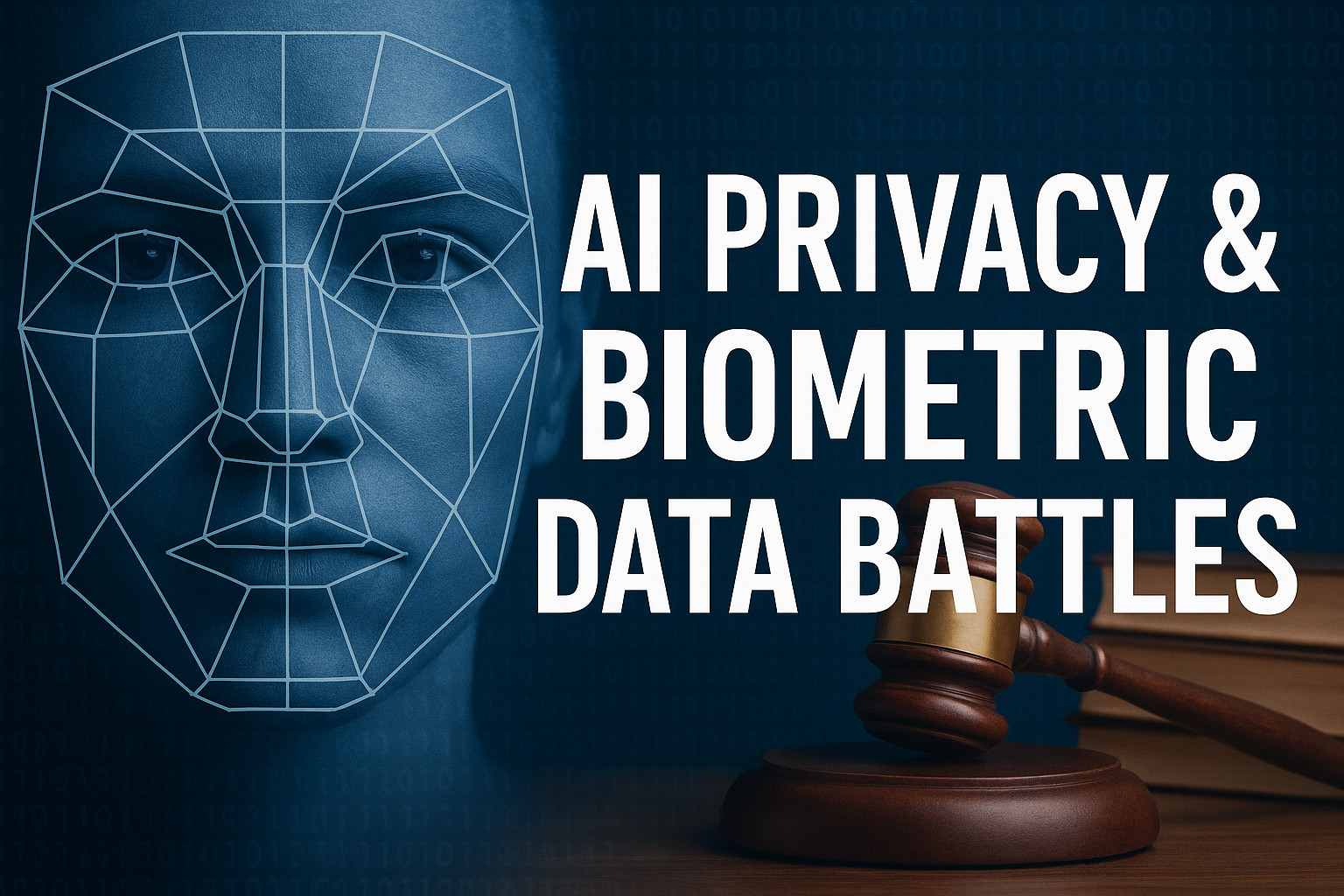
Privacy & Biometric Data Cases: AI’s Growing Legal Battleground
As artificial intelligence becomes more embedded in daily life, privacy and biometric data usage have emerged as some of the most contentious issues in global courts. From facial recognition to voiceprints, AI systems increasingly rely on sensitive personal information to function effectively. But where does innovation cross the line into invasion of privacy? Recent lawsuits against tech giants like Meta, Google, Amazon, and Clearview AI shed light on how legal systems are starting to define these boundaries.
The Rise of Biometric Data in AI
Biometric data includes unique biological identifiers such as fingerprints, facial geometry, voice patterns, and even gait recognition. AI systems leverage these data points for security (e.g., unlocking phones), personalization (e.g., targeted ads), and efficiency (e.g., automated hiring tools). However, because biometric identifiers are immutable – unlike passwords – they pose unique risks when misused or compromised.
In jurisdictions like the United States, particularly Illinois with its Biometric Information Privacy Act (BIPA), courts have become the frontline for testing whether AI companies are complying with laws designed to protect individuals from unauthorized data collection.
Clearview AI: The $50 Million Settlement
One of the most high-profile cases is Clearview AI, a company infamous for scraping billions of publicly available images from social media platforms to build a facial recognition database. Law enforcement agencies used this database, but critics argued it amounted to mass surveillance without consent.
In response to multiple lawsuits, Clearview AI agreed to a $50 million settlement, a significant figure that highlights both the financial and reputational risks AI companies face when they overreach. The case also underscores growing global concern about how biometric data is sourced and whether consent is truly obtained.
Meta’s Record-Breaking Fine in Texas
Meta (formerly Facebook) faced a $1.4 billion penalty in Texas, the largest of its kind, over its “Tag Suggestions” feature that automatically identified and tagged people in photos. The court found Meta had violated state biometric privacy laws by collecting and storing facial geometry without explicit user consent.
This ruling set an important precedent: even innovative features framed as user-friendly enhancements must comply with privacy laws. It serves as a warning that AI-driven personalization cannot come at the cost of individual rights.
Google’s Privacy Settlement
Google also found itself in the crosshairs, settling a $1.4 billion lawsuit in Texas over misuse of biometric and location data. Plaintiffs alleged that Google’s data collection practices extended far beyond what users reasonably expected when using its services. This settlement reflects a growing judicial willingness to impose heavy penalties on tech companies that fail to maintain transparency around AI-powered data collection.
Amazon Rekognition: The BIPA Challenge
Amazon’s facial recognition service, Rekognition, has been targeted in a class-action lawsuit in Illinois under BIPA. Plaintiffs argue that Rekognition unlawfully scanned and stored facial data from users’ photos without consent. The outcome of this case could have wide-reaching implications for cloud services and enterprise AI providers, potentially forcing them to redesign or restrict biometric features.
Voice Data Cases: Delgado v. Meta
Voiceprints have also entered the legal spotlight. In Delgado v. Meta, plaintiffs claimed that Meta secretly collected and stored voice data from users, creating unique voiceprints without consent. The case has advanced to the summary judgment stage, indicating courts take such allegations seriously. If proven, this case could open the door to stricter regulations around voice-based AI systems, such as smart assistants and customer service bots.
Why These Cases Matter
Together, these cases mark the beginning of a legal framework around privacy and AI. They signal that:
- Consent is Non-Negotiable – Companies must obtain explicit consent before collecting biometric data.
- Transparency is Key – Users should know how their data is being collected, stored, and used.
- Penalties Will Be Severe – Fines in the billions show that courts are willing to impose significant financial consequences.
Looking Ahead
As AI continues to evolve, so too will the legal standards governing privacy and biometric data. Countries beyond the U.S., including members of the European Union and Asian nations, are drafting stricter regulations. Companies deploying AI must adapt quickly or risk devastating financial and reputational fallout.
The privacy and biometric data battles highlight a central tension of the AI age: the promise of personalization versus the right to privacy. Courts are increasingly signaling that the latter cannot be sacrificed, no matter how groundbreaking the technology.
Sources
https://therecord.media/clearview-ai-illinois-class-action-lawsuit-settlement
https://thehackernews.com/2024/07/meta-settles-for-14-billion-with-texas.html
https://law.justia.com/cases/federal/district-courts/california/candce/3:2023cv04181/416963/55