Kubernetes has become a widely adopted orchestration layer for running stateful systems, including analytical databases like ClickHouse®.
This post explains what the ClickHouse® Kubernetes Operator is, why it was introduced, and what it means for teams running ClickHouse® on Kubernetes.
What Is a Kubernetes Operator?
A Kubernetes operator extends the Kubernetes API to manage complex applications declaratively. It uses custom resource definitions (CRDs) to model application state – making deployment, scaling, upgrades, and recovery automated and repeatable.
Operators follow the operator design pattern – capturing human operational knowledge in software so users can treat complex distributed systems like ClickHouse as first-class Kubernetes resources.
Introducing the ClickHouse Kubernetes Operator
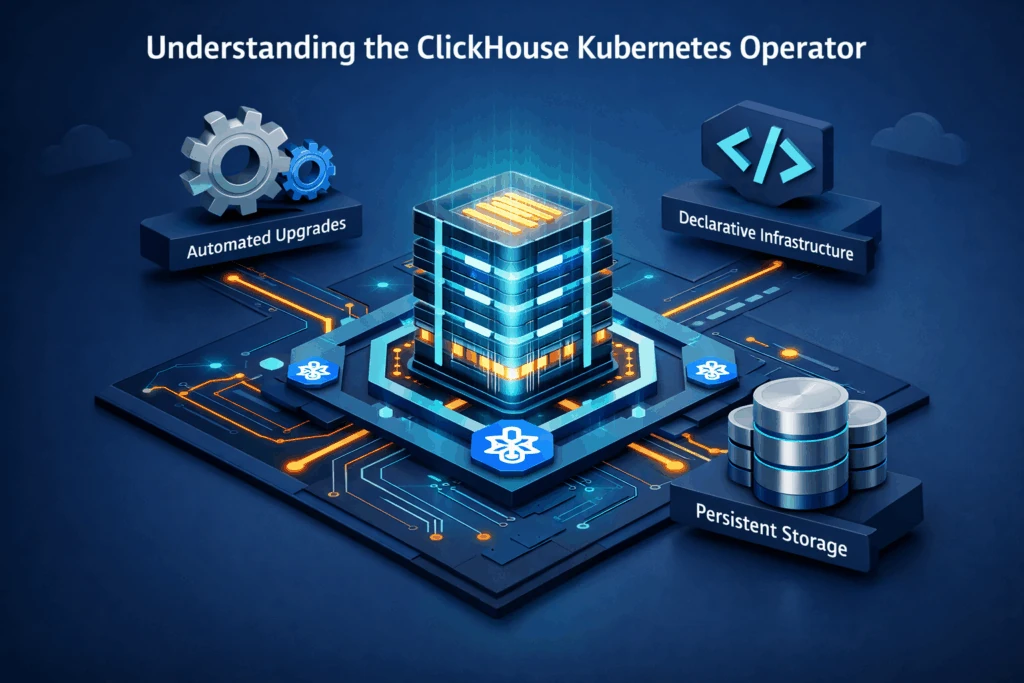
The ClickHouse® Operator for Kubernetes automates the deployment and lifecycle management of ClickHouse® clusters in a Kubernetes environment. Instead of manually configuring StatefulSets, Services, and PersistentVolumes, you describe your desired cluster state in a CRD manifest, and the operator handles the rest: creating pods, configuring storage, wiring high availability, and ensuring smooth upgrades.
Core Capabilities
The operator delivers:
- Cluster lifecycle automation: Create, scale, and delete ClickHouse clusters declaratively.
- High availability: Built-in support for fault-tolerant ClickHouse® clusters and ClickHouse® Keeper for coordination.
- Persistent storage provisioning: Customizable PVC templates with storage class controls.
- Configuration management: Centralized and automated configuration across replicas.
- Observability: Metrics integration with Prometheus and Kubernetes monitoring tools.
This means the operator manages day-0 and day-n operations – deployments today and scaling, upgrades, and maintenance tomorrow.
Why This Matters for ClickHouse® Users
Declarative Infrastructure, Not Scripts
Traditionally, running ClickHouse® in Kubernetes required:
- Manual manifests
- Custom scripting
- Ad-hoc automation
The operator flips that model around. You declare the desired cluster state once, and Kubernetes – with the operator – reconciles reality with intent. This drastically reduces operational complexity as clusters grow or change.
Seamless High Availability
High-availability setups traditionally involve careful orchestration of replicas and coordination services such as ZooKeeper or ClickHouse® Keeper. The operator handles:
- Pod placement
- Replica management
- Rolling upgrades
- Keeper cluster provisioning
All declaratively.
That means teams no longer need brittle automation scripts or manual rollout plans – the operator ensures correctness.
Better Scaling and Upgrades
ClickHouse clusters often need dynamic scaling – adding nodes during peak workloads, resizing storage classes, or updating configurations.
The operator:
- Applies upgrades with minimal downtime
- Scales clusters declaratively
- Handles replica configuration propagation automatically
These capabilities are especially valuable for production environments where uptime and predictability matter.
Open-Source Support and Ecosystem Effects
The operator is part of the ClickHouse® open-source ecosystem – supporting users beyond just Cloud customers:
- It is first-party, maintained by the ClickHouse® project itself.
- It embraces Kubernetes-native principles and CRDs.
- It integrates with Cloud-native observability (e.g., Prometheus).
This means community users benefit from the same automation primitives that Cloud customers use, fostering consistency between self-managed and managed deployments.
Benefits for ClickHouse® Cloud Users
For ClickHouse Cloud, the operator provides:
1. Unified Management Experience
Cloud operators manage clusters with greater consistency, removing manual steps and improving reliability for users across AWS, GCP, and Azure.
2. Observability and Monitoring
With built-in observability hooks, Cloud users can integrate ClickHouse® metrics into their existing dashboards and alerting systems – no bespoke instrumentation required.
3. Faster Iteration
Development teams can spin up and tear down clusters quickly using declarative manifests – ideal for rapid experimentation or ephemeral analytics workloads.
How the Operator Compares to the Older Community Options
Prior to this first-party operator, many ClickHouse® deployments on Kubernetes relied on community or third-party operators (e.g., from Altinity) – which also provided automation but varied in support and integration. (GitHub)
The new official operator:
- Aligns more closely with upstream ClickHouse® releases
- Receives consistent updates with core features in mind
- Reduces reliance on external operators
However, open-source alternatives and tooling still exist and continue to innovate alongside the official operator, underscoring a healthy ecosystem.
Real-World Use Cases
The operator patterns shine in scenarios like:
- Enterprise analytics clusters requiring HA and scaling
- Self-managed cloud deployments with automated upgrades
- Dev environments where ephemeral clusters spin up and down
- Hybrid deployments combining Cloud and on-prem systems
Challenges and Considerations
No tool is perfect. Some things to consider:
- Kubernetes fundamentals are still required – understanding PersistentVolumes, CRDs, and Kubernetes RBAC is essential.
- Debugging at the Kubernetes layer may require additional observability tools.
- Operator maturity and ecosystem integration will continue to evolve (e.g., support for custom autoscalers).
Exploring ClickHouse® for Your Analytics?
At Quantrail Data, we help teams run ClickHouse® reliably for real-time analytics – from Kubernetes deployments and migrations to performance tuning in production.
We see these challenges firsthand while supporting demanding analytics workloads. In one recent engagement, a customer achieved near bare-metal performance with ClickHouse® in production – a story we’ve shared here:
Success Story: Quantrail Bare-Metal ClickHouse® Deployment
If you’re evaluating ClickHouse® or trying to get more out of an existing setup, we’re happy to share practical lessons from real-world deployments.
Contact
Quantrail Data
Conclusion
The ClickHouse® Kubernetes Operator is a major step forward in operationalizing ClickHouse on Kubernetes. By embracing declarative management, robust lifecycle automation, and built-in observability, it brings production-grade capabilities to both Cloud users and the open-source community.
If you’re running analytical workloads in Kubernetes, this operator dramatically simplifies your operational burden – freeing your team to focus on insights, not infrastructure.
References
Introducing the Official ClickHouse Kubernetes Operator: Seamless Analytics at Scale
ClickHouse Operator Documentation